
How to Use AI to Personalize Outreach Messages at Scale
Learn how to use AI to personalize outreach messages at scale, boost open and reply rates, and build real pipeline using data-driven personalization strategies.
1/20/20264 min read
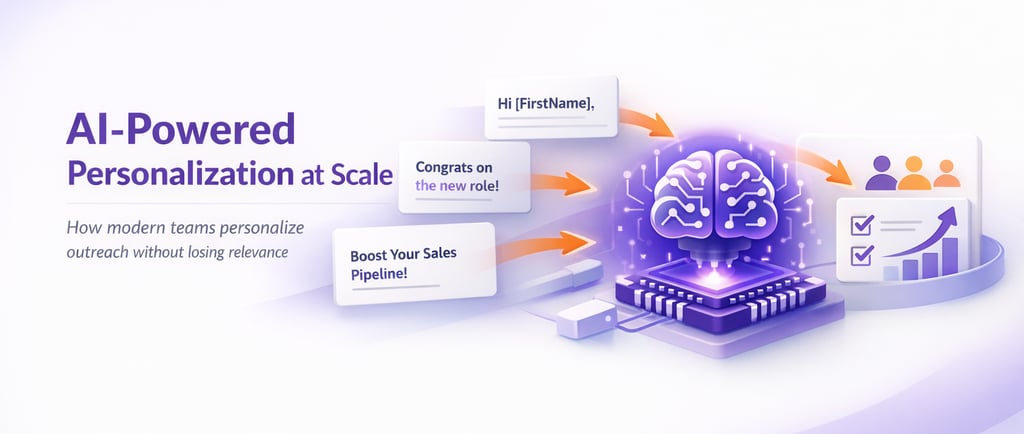
How to Use AI to Personalize Outreach Messages at Scale (and Get Real Results)
Using AI to personalize outreach messages at scale dramatically improves engagement and conversions, and you don’t have to send one-off emails manually to get there. In fact, AI-driven personalization can boost open and reply rates by double digits compared with generic outreach, helping teams build real pipeline at scale.
Here’s the answer up front:
AI works by analyzing real data about your prospects (like firmographics, behavior, and intent) to tailor messages that feel custom to each recipient, even when you’re sending thousands. This blend of data, AI logic, and human strategy allows teams to break the age-old tradeoff between personal and scalable.
This article uses up-to-date research and statistics to clearly explain how AI personalization works, why it matters, and how you can use it right.
Why Personalization at Scale Is Critical Today
Most outreach campaigns fail because they feel generic. Industry data shows that up to 91.5% of outreach emails get no response at all, and personalization can dramatically improve those odds.
When you personalize:
Emails tailored to recipients can see 32% higher response rates and customized subject lines can improve open rates by around 50%.
Companies that excel at personalization generate as much as 40% more revenue than their peers.
Buyers increasingly expect tailored communication, with 73% of buyers preferring AI-enabled personalization from brands.
The takeaway? Personalization isn’t optional, it’s table stakes.
The Problem with Traditional Outreach
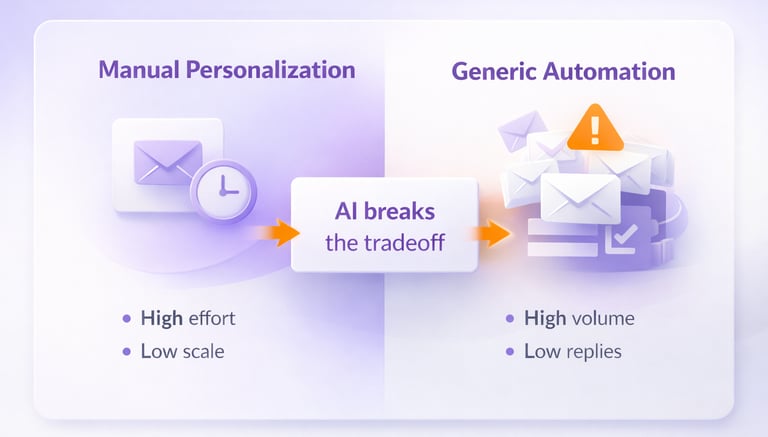
Here’s the real issue: historically, teams have faced a frustrating choice:
Manual personalization: great quality, zero scale
Automated templates: high scale, poor engagement
Most solutions fall into the latter category, resulting in generic messages that prospects ignore. This is especially true in B2B outreach, where buyers now expect messages that speak to their specific challenges, role, or industry.
That’s where AI comes in.
How AI Actually Personalizes Messages at Scale
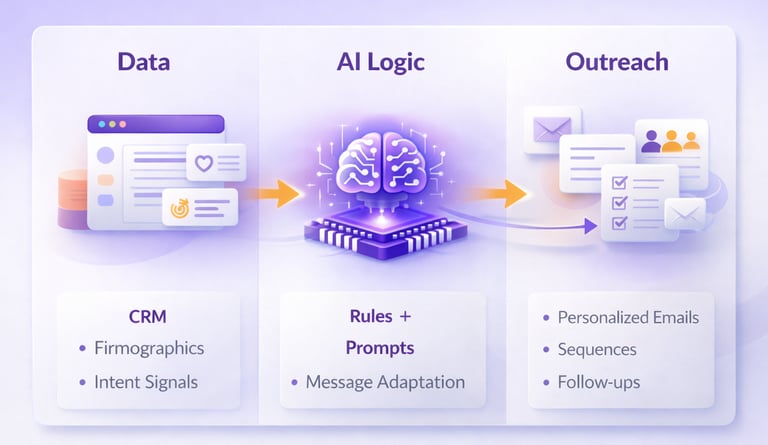
AI isn’t magic, but it is incredibly good at recognizing patterns and tailoring messages based on data you already have. Here’s how it works in practice:
1. Data-Driven Insights
AI systems pull information from multiple sources, CRM data, engagement history, intent signals, and firmographics, to build context for each recipient before writing a message. This moves beyond superficial personalization (like just adding a name).
2. Adaptive Message Frameworks
Instead of writing each email from scratch, AI uses proven messaging frameworks and adapts them for different audiences:
Role-specific versions (e.g., VP vs. Manager)
Industry-relevant hooks (e.g., SaaS vs. manufacturing)
This keeps messages coherent while still relevant and tailored.
3. Scalable Templates with Custom Logic
AI can generate variations of outreach sequences based on performance data, audience segments, and real-time signals. You get personalized flowing cadences instead of one generic blast.
Proof That AI Personalization Works
The data backs this up:
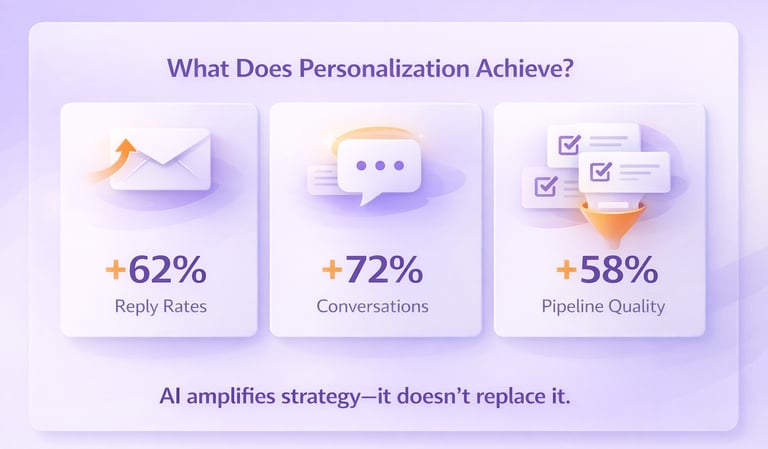
✔ Personalized outreach sees greater engagement: emails tailored to recipients have 32% higher response rates than generic ones.
✔ Custom subject lines boost open rates by up to 50%, a huge driver of engagement.
✔ AI personalization can multiply reply rates by up to 8x compared with standard outreach.
✔ Modern buyers expect tailored communication, 73% prefer personalized experiences.
These improvements don’t just look good on paper, they translate into real pipeline growth and meaningful conversations with decision-makers.
Common Missteps When Scaling with AI
Even powerful AI can fail if misused. Here’s what teams often get wrong:
Relying only on superficial tokens (like inserting a name) instead of meaningful context
Skipping data quality, AI is only as good as the data it uses
Treating AI like a creative replacement rather than a strategic assistant
Optimizing send volume over meaningful engagement
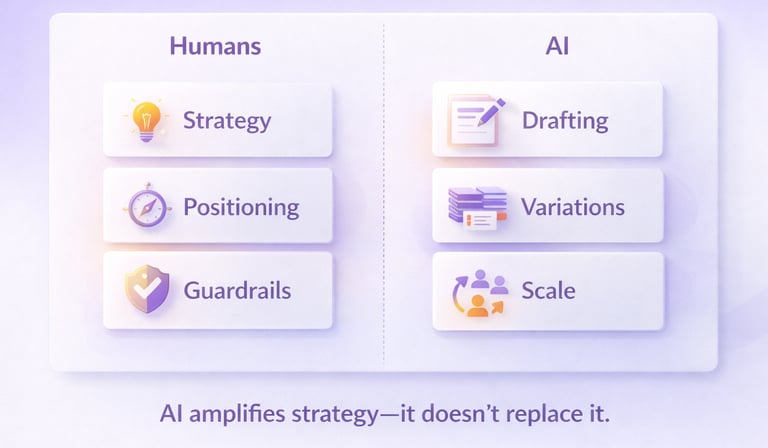
AI amplifies what already exists. If your message strategy is weak, AI simply scales bad messaging faster.
How to Do AI Personalization the Right Way
Here’s a practical, step-by-step approach:
1. Build a Strong Data Foundation
Ensure your CRM is clean, complete, and enriched with firmographics and intent signals. AI depends on quality data to make relevant decisions.
2. Define Core Messaging Frameworks
Map your core value propositions and audience segments. Let humans set the strategy, AI optimizes the execution.
3. Use AI for Personalization Logic
Let AI tailor props, openers, and sequence variations within guardrails you define.
4. Test, Measure, Refine
Track open rates, reply rates, meetings booked, and pipeline created. Let these metrics guide iteration.
Final Thoughts
Personalizing outreach messages at scale isn’t just about tools, it’s about systems, strategy, and data working together. AI unlocks personalization without manual workload, but it thrives in structured environments.
If you implement AI with discipline, building around data quality and messaging strategy, you get the best of both worlds:
🔹 Scale
🔹 Relevance
🔹 Better engagement
🔹 More pipeline growth
Personalization no longer needs to be a tradeoff between people and technology, it can be both.
Frequently asked questions
1. What exactly does Forsify do?
Forsify operates as an AI-powered marketing department that designs, builds, and runs growth systems end to end.
We engineer:
Market positioning and messaging
Authority and demand creation
Outbound, inbound, and nurturing systems
Continuous experimentation and optimization
Our goal is not “more leads” it’s predictable, scalable growth.
2. How is this different from a marketing agency?
Agencies execute tasks. Forsify creates and runs growth engines.
With Forsify, you get:
Growth architecture, not isolated campaigns
AI-driven execution across content, outreach, and nurturing
Continuous testing, iteration, and learning
One integrated system instead of disconnected tools and vendors
We function like a senior in-house marketing team, without the overhead.
3. What problems does Forsify solve?
Forsify solves structural growth problems, including:
Inconsistent demand and revenue volatility
High CAC from paid channels alone
Fragmented marketing tools and teams
Lack of ownership over growth strategy and execution
We replace guesswork with a repeatable, data-driven growth engine.
4. Who is this best suited for?
Forsify works best for:
B2B companies and startups with complex sales cycles
Teams selling high-ACV products or services
Founders who need growth without building a large internal team
If growth is strategic to your business, not an experiment, this is a fit.
5. What does the AI Marketing Department include?
Depending on your configuration, it may include:
Positioning, ICP, and messaging engineering
Authority-building content and thought leadership
Automated outbound and demand capture
Lead nurturing and conversion systems
Analytics, reporting, and optimization loops
All components are designed to work together as one system.
6. How long does it take to see results?
Growth is engineered in phases:
Setup Sprint:
Strategy, infrastructure, ICP, workflows, content, and channel warm-upExecution Phase:
The system goes live, compounds over time, and improves through testing
Meaningful traction typically appears within 20–40 days, with compounding results over time.
7. Is Forsify replacing our internal marketing team?
Not necessarily.
Forsify can:
Act as your entire marketing department, or
Work alongside internal teams to design and run growth engines
We integrate into your existing structure rather than compete with it.
8. How much involvement is required from our team?
Minimal executive involvement.
You’ll be involved in:
Strategic alignment and approvals
Monthly reviews and optimization decisions
Day-to-day execution is handled by Forsify and AI-powered systems
9. Do you only focus on outbound and pipelines?
No.
Pipeline creation is one outcome, not the product.
Forsify focuses on:
Demand creation
Brand authority
Conversion optimization
Long-term growth infrastructure
Pipelines improve because the system works, not because we push volume.
10. How do you measure success?
Success is measured by:
Growth in qualified demand
Conversion rates across the funnel
Cost efficiency versus internal teams
Strategic impact on revenue
KPIs are defined upfront based on your business model.
Forsify
Transform Your Business with AI.
149 New Montgomery st., San Francisco, CA
info@forsify.com
© 2026. All rights reserved.