
How to Warm Up Email and LinkedIn Accounts for Cold Outreach
(Without Burning Your Reputation)
12/30/20255 min read
The main topic is simple: Your email and LinkedIn outreach will only work if your accounts are properly warmed up and warming up is the single most important factor determining whether prospects ever see your message.
Does warming up actually improve deliverability and response rates?
Yes. Research from Google Postmaster Tools and LinkedIn’s internal spam-prevention guidelines shows that new or inactive accounts are automatically throttled until they build positive reputation signals. High-quality warm-up activity directly improves inbox placement, reduces account restrictions, and increases your chances of generating reply-driven pipeline.
Proof & Credible Sources
Google and Microsoft publicly state that sender reputation is the primary determinant of inbox placement (Google Postmaster Tools Documentation; Microsoft SNDS).
LinkedIn’s Help Center outlines trust-based activity thresholds that limit new accounts’ messaging and connection activity.
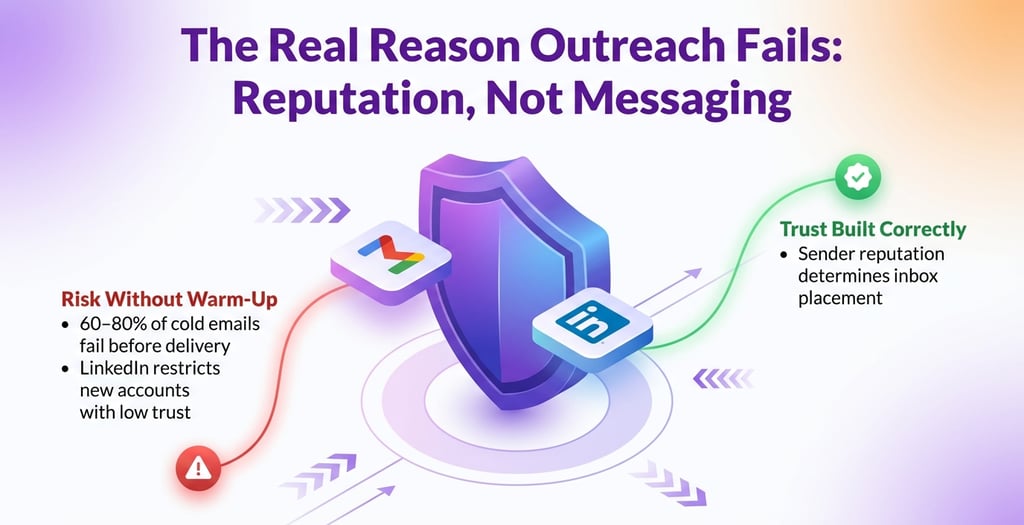
Email deliverability analysts consistently report that 60–80% of cold outreach failures happen before the message is even delivered due to poor domain reputation (Validity 2024 Email Benchmark Report).
Context (within the first few sentences)
Most teams assume cold outreach fails because of the message or the offer. But in reality, platforms like Gmail and LinkedIn evaluate your trustworthiness long before a human ever has the chance to read what you wrote. That means even great messaging gets buried if your account reputation is weak.
Now let’s break down what destroys deliverability, and how to warm up correctly.
Companies try to scale outbound before proving to platforms that their accounts behave like real humans.
When accounts look new, automated, or suspicious:
Emails slip into spam quietly
LinkedIn limits your daily actions
Sender reputation tanks
Future campaigns underperform, even if the messaging improves
This is why warm-up isn’t a “nice to have.”
It’s GTM infrastructure , the backbone of predictable pipeline.
A Complete, Research-Backed Warm-Up System
Below is a breakdown of how to properly warm up email and LinkedIn, backed by deliverability standards and platform trust signals.
How to Warm Up Your Email (Step-by-Step)
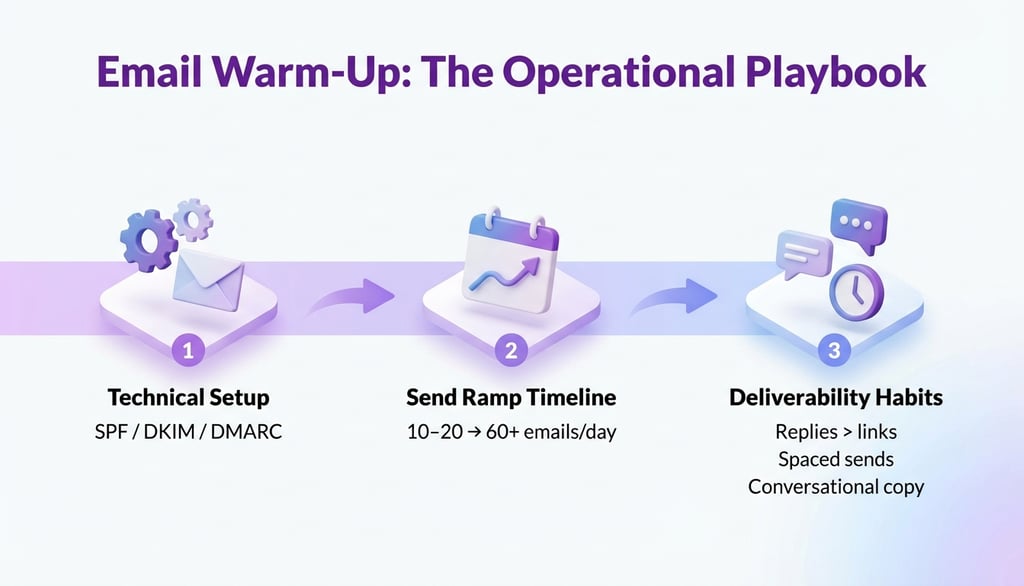
1. Start With Technical Foundations
These authentication records signal to inbox providers that you're legitimate:
SPF, DKIM, DMARC (industry-standard authentication protocols)
A branded domain + subdomain
Clean, minimal signature
Human-looking profile photo
Research insight: Domains without SPF/DKIM have 70% lower inbox placement according to Mailwarm and SendGrid deliverability testing.
This is the foundation Forsify builds for scaling GTM teams.
2. Begin With a Gentle Send Ramp
You must look undeniably human for 2–4 weeks:
10–20 manual emails per day
Mix internal replies + warm conversations
Gradually increase volume
Target 60%+ opens and 20%+ replies
Your goal: prove humans enjoy interacting with you.
3. Build Good Deliverability Habits
Small behaviors → big impact.
Avoid links the first 1–2 weeks
Keep copy conversational
Prioritize replies, not broadcasts
Space out sends manually
Tools help after trust is established, not before.
How to Warm Up Your LinkedIn Account (Step-by-Step)
LinkedIn is a trust platform. Accounts with low credibility signals get throttled.
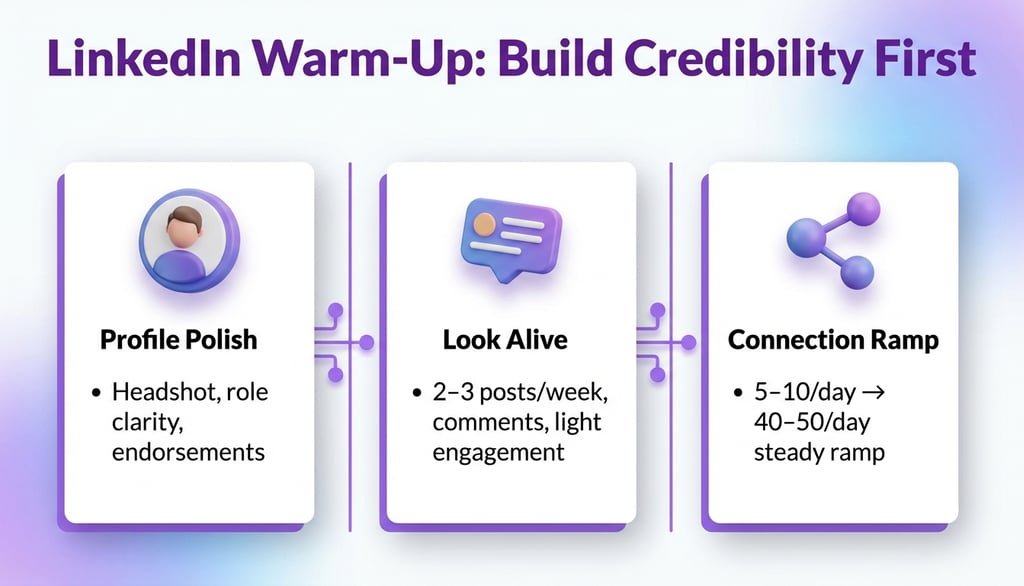
1. Polish Your Profile (Just Enough)
You don’t need creator-level branding. Just credibility.
Clear headshot
Simple, readable role description
Connected to your company page
A handful of skills + endorsements
Sparse or incomplete profiles trigger restriction risks.
2. Look Alive on the Platform
LinkedIn tracks behavioral signals.
Do this:
2–3 short posts/week
A few meaningful comments
Engage with industry content
You’re telling the algorithm:
“I’m a human who contributes, not a bot.”
3. Ramp Up Connection Requests Slowly
LinkedIn monitors velocity and acceptance rate:
Week 1: 5–10/day
Week 2–3: 20–30/day
Week 4: 40–50/day max
Maintain 40%+ acceptance to avoid throttling.
A one-line personal note is enough.
Sustainable Warm-Up Principles
These principles separate predictable pipeline from outreach chaos:
Consistency beats volume
Avoid sudden spikes
Diversify message styles
Monitor bounce rates
Do not automate until trust is earned
Warm-up isn’t slow, it’s the runway revenue teams need.
Common Mistakes Companies Make
❌ Buying “pre-warmed” domains
❌ Going from 0 to 300 emails/day
❌ Skipping DNS + authentication setup
❌ Using templates that trigger spam filters
❌ Automating before reputation is built
Outbound fails when treated like a task.
Outbound works when treated like a system.
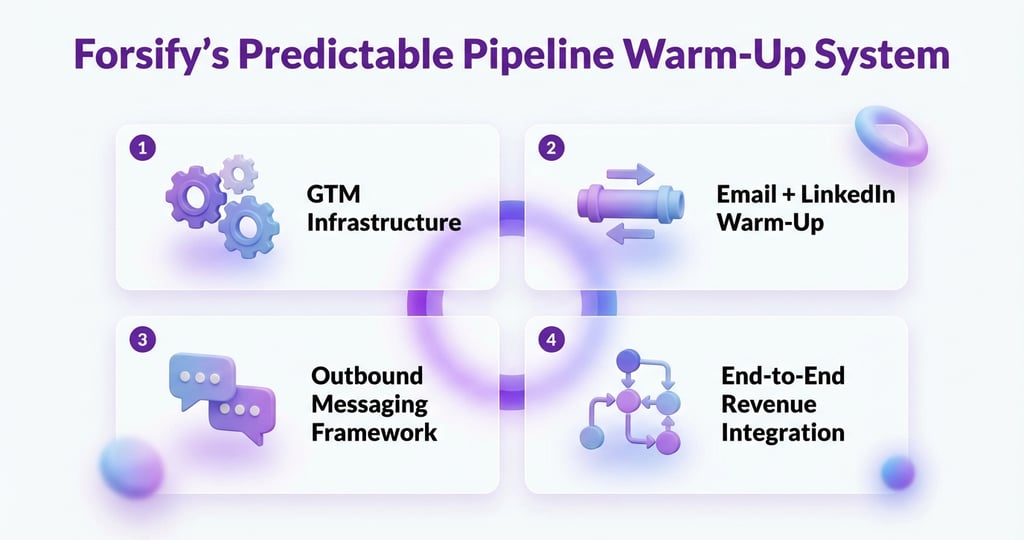
How Forsify Helps Teams Build a Warm-Up System That Scales
Forsify builds the revenue foundation behind consistent outbound:
Clean, compliant GTM infrastructure
Email + LinkedIn warm-up systems
Conversion-driven outbound messaging
Integration into your broader revenue engine
It’s not about sending more messages.
It’s about building a trust-based system that earns replies and drives predictable pipeline.
Cold outreach in 2026 doesn’t start with a message.
It starts with reputation, trust, and operational readiness.
Frequently asked questions
1. What exactly does Forsify do?
Forsify operates as an AI-powered marketing department that designs, builds, and runs growth systems end to end.
We engineer:
Market positioning and messaging
Authority and demand creation
Outbound, inbound, and nurturing systems
Continuous experimentation and optimization
Our goal is not “more leads” it’s predictable, scalable growth.
2. How is this different from a marketing agency?
Agencies execute tasks. Forsify creates and runs growth engines.
With Forsify, you get:
Growth architecture, not isolated campaigns
AI-driven execution across content, outreach, and nurturing
Continuous testing, iteration, and learning
One integrated system instead of disconnected tools and vendors
We function like a senior in-house marketing team, without the overhead.
3. What problems does Forsify solve?
Forsify solves structural growth problems, including:
Inconsistent demand and revenue volatility
High CAC from paid channels alone
Fragmented marketing tools and teams
Lack of ownership over growth strategy and execution
We replace guesswork with a repeatable, data-driven growth engine.
4. Who is this best suited for?
Forsify works best for:
B2B companies and startups with complex sales cycles
Teams selling high-ACV products or services
Founders who need growth without building a large internal team
If growth is strategic to your business, not an experiment, this is a fit.
5. What does the AI Marketing Department include?
Depending on your configuration, it may include:
Positioning, ICP, and messaging engineering
Authority-building content and thought leadership
Automated outbound and demand capture
Lead nurturing and conversion systems
Analytics, reporting, and optimization loops
All components are designed to work together as one system.
6. How long does it take to see results?
Growth is engineered in phases:
Setup Sprint:
Strategy, infrastructure, ICP, workflows, content, and channel warm-upExecution Phase:
The system goes live, compounds over time, and improves through testing
Meaningful traction typically appears within 20–40 days, with compounding results over time.
7. Is Forsify replacing our internal marketing team?
Not necessarily.
Forsify can:
Act as your entire marketing department, or
Work alongside internal teams to design and run growth engines
We integrate into your existing structure rather than compete with it.
8. How much involvement is required from our team?
Minimal executive involvement.
You’ll be involved in:
Strategic alignment and approvals
Monthly reviews and optimization decisions
Day-to-day execution is handled by Forsify and AI-powered systems
9. Do you only focus on outbound and pipelines?
No.
Pipeline creation is one outcome, not the product.
Forsify focuses on:
Demand creation
Brand authority
Conversion optimization
Long-term growth infrastructure
Pipelines improve because the system works, not because we push volume.
10. How do you measure success?
Success is measured by:
Growth in qualified demand
Conversion rates across the funnel
Cost efficiency versus internal teams
Strategic impact on revenue
KPIs are defined upfront based on your business model.
Forsify
Transform Your Business with AI.
149 New Montgomery st., San Francisco, CA
info@forsify.com
© 2026. All rights reserved.