
Lead Generation for B2B SaaS Without a Large SDR Team: 7 Scalable Strategies for 2026
Learn how B2B SaaS companies can build predictable lead generation without hiring a large SDR team. Discover inbound, automation, intent data, and partnership strategies for scalable growth in 2026.
1/27/20264 min read
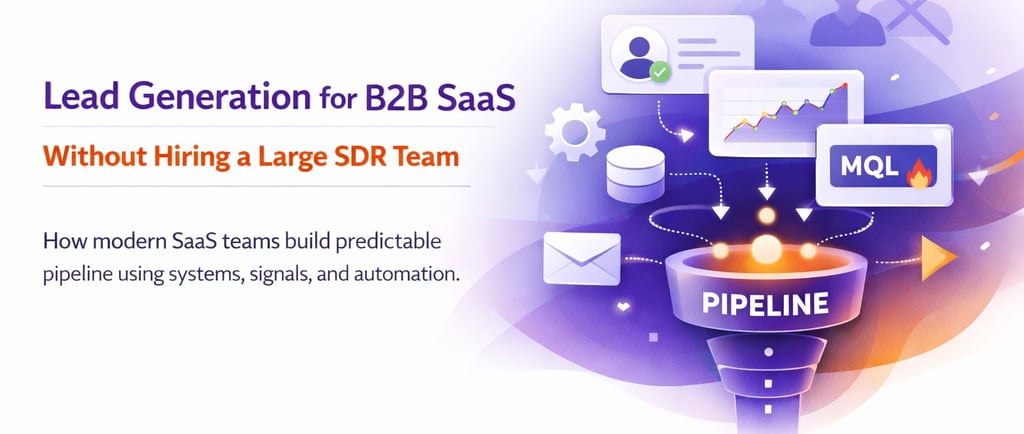
Lead generation for B2B SaaS companies without hiring a large SDR team is absolutely possible, and increasingly necessary in 2026 to reduce costs, accelerate pipeline growth, and focus on high-quality prospects.
Research shows that effective lead gen today isn’t just about outbound volume or brute force SDR hiring, it’s about building systems and signals that drive qualified interest consistently.
In this article, you’ll get actionable strategies and data-backed insights to build a scalable lead generation engine without expanding your SDR bench, from inbound demand capture to automation and partnership levers that actually move the needle.
Why You Don’t Need a Large SDR Team (And What You Do Need)
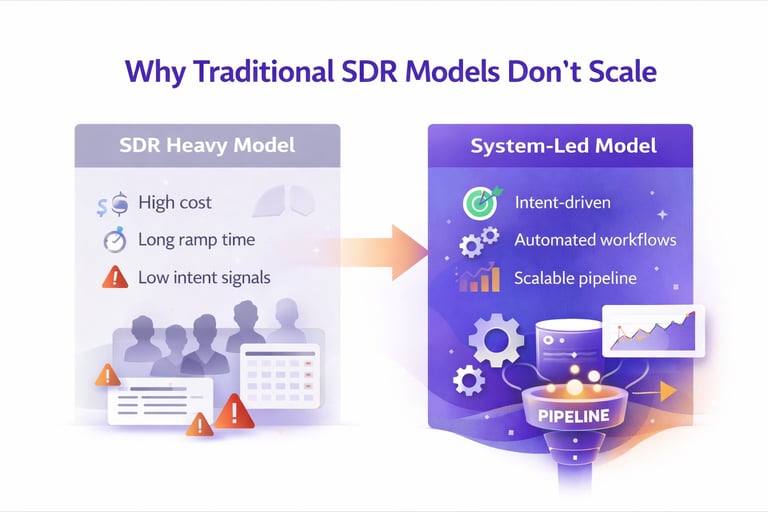
Traditional SDR playbooks, hiring reps to churn cold outreach, come with high costs, long ramp time, and unpredictable outcomes. At fully loaded costs of $90K–$140K per SDR per year, it’s easy for teams to burn cash without building predictable pipeline.
Buyers have also changed: B2B buyers now spend the majority of their purchase journey researching on their own before engaging a vendor, which means systemic demand and intent capture matter more than pure outreach volume. Averi
So instead of scaling headcount, today’s SaaS growth leaders focus on systems, signals, and automation, here’s how.
1. Build an Inbound Engine That Converts
Inbound lead generation isn’t just blogging, it’s content designed to capture demand at every stage of the buyer journey. High-value content like case studies, ROI calculators, and comparison guides attracts prospects who are already evaluating solutions.
Why this works: Inbound channels have long ROI tails. For example:
SEO and organic content can generate massive ongoing visibility as authority builds.
Email marketing often yields $36–$40 in return for every $1 spent.
Action steps:
Map content to the funnel (TOFU, MOFU, BOFU)
Use topic clusters and keyword research to drive organic traffic
Gate high-intent content with smart lead magnets
The result: qualified leads that arrive already educated and warm, reducing the need for SDR outreach.
2. Use Product & Website Signals to Surface Leads
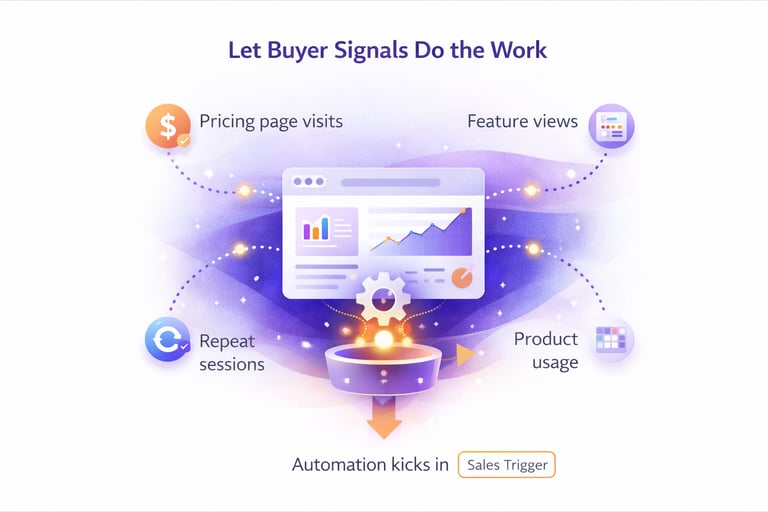
Not all leads come from form fills. Modern systems capture behavioral signals, like product usage, repeated page views, pricing page visits, and content engagement, to trigger automated follow-up.
Why this matters: 70% of B2B purchase journeys happen before a prospect fills out a demo form.
Strategies:
Track intent behaviors with tools like Clearbit, Apollo, or visitor identification platforms.
Score leads automatically based on actions (lead scoring).
Route high-intent leads into nurturing workflows or sales triggers
With this, behavior becomes your SDR, highlighting the prospects most likely to convert and enabling automated sequences to nurture them.
3. Automate Outbound Without Manual SDR Labor
Outbound can still work, but instead of dozens of SDRs, leverage automation, personalization, and multichannel outreach to generate meetings.
Key tactics:
Run cold email + LinkedIn sequences with AI-assisted personalization.
Maintain sender reputation and list hygiene to keep reply rates strong.
Use multi-touch cadences that resonate with targeted ICP segments
Modern outbound platforms let one operator run what used to take a team, reducing manual headcount while keeping quality up.
4. Turn Partnerships Into a Lead Channel
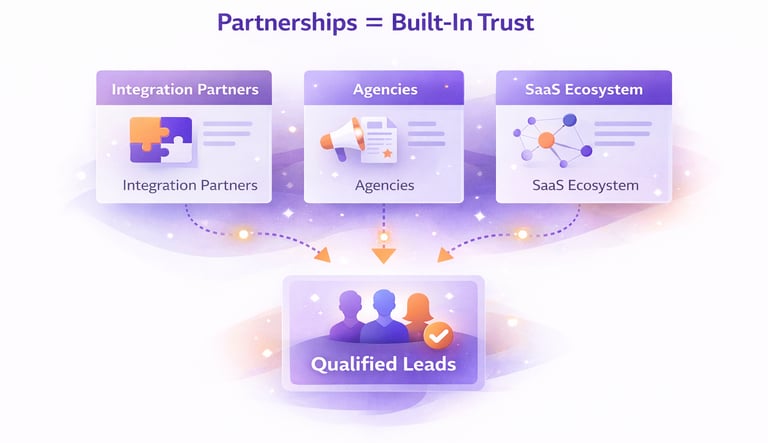
Strategic partnerships unlock external networks and co-marketing opportunities rather than forcing you to build from scratch.
Examples:
Integration partners hosting joint webinars
Agency referral programs
Content syndication with complementary SaaS tools
Partnership leads often convert at higher rates because they come with trusted introductions and context already baked in.
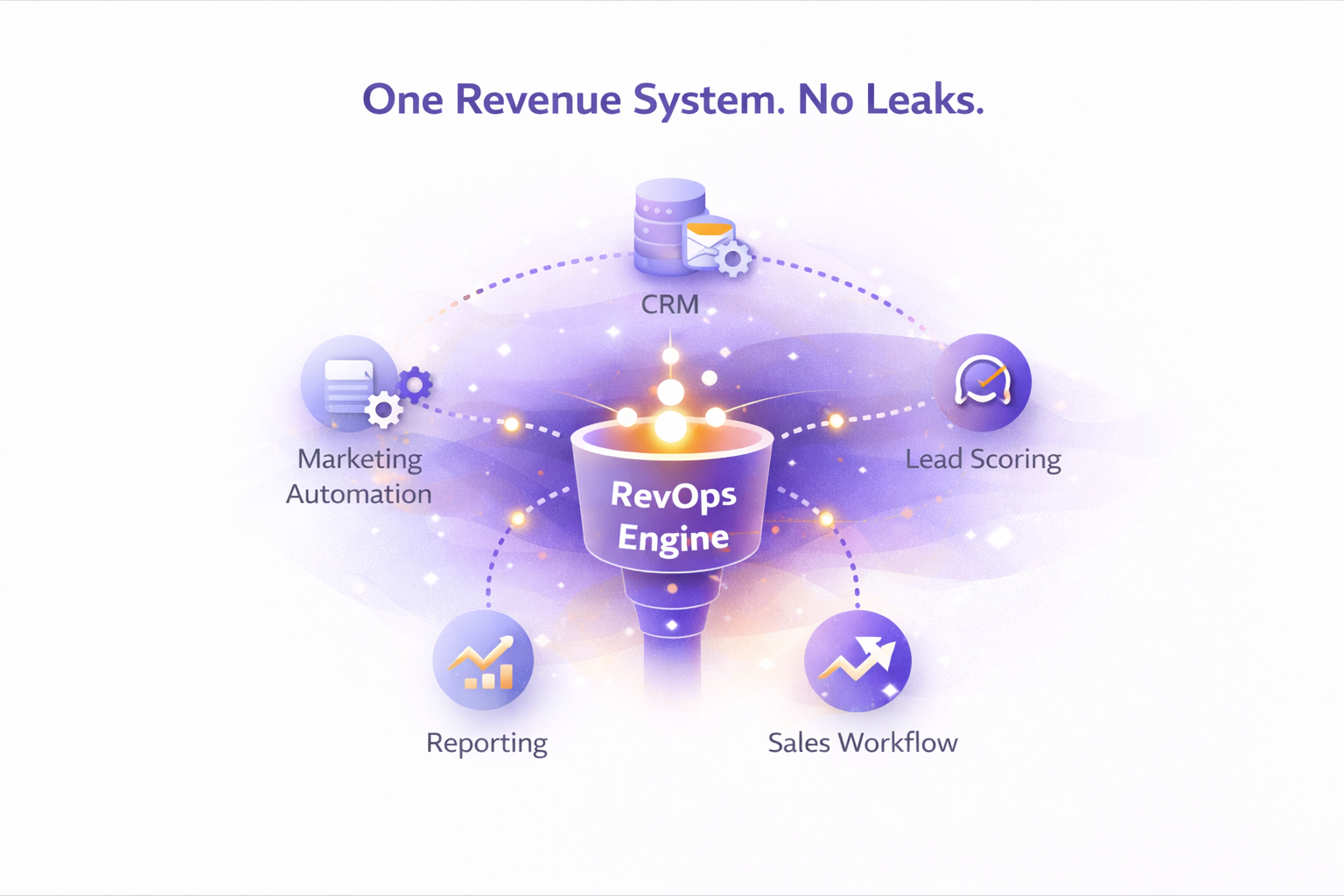
5. Centralize Everything With RevOps Automation
One core advantage of avoiding SDR headcount is eliminating process breakpoints that sap pipeline efficiency.
A strong RevOps system connects:
CRM
Marketing automation
Lead scoring
Intent data
Nurture sequences
This unified stack:
Saves manual handoffs
Improves tracking and reporting
Reduces lead leakage
Example benefit: Automated rules ensure that only high-intent leads surface to sales workflows, meaning less noise and more revenue-ready opportunities.
Why This Approach Works Better Than an SDR Army
Traditional SDR Model
System-Driven Model
High cost, slow scale
Lower cost, scalable systems
Manual, inconsistent
Automated, repeatable workflows
Reliant on headcount
Reliant on signals and intent
Activity focused
Pipeline and revenue focused
In a market where buyers self-educate and trust engines like search and product signals more than cold outreach, systems outperform sheer headcount.
Final Thoughts
Yes, you can build predictable lead generation for B2B SaaS without hiring a large SDR team. The key is to shift from labor-intensive outreach to systemic, signal-driven pipeline engines built on automation, intent capture, inbound content, and strategic partnerships.
When done right, this approach delivers higher-quality leads, faster conversions, lower costs, and greater scalability, all without the overhead of a big SDR bench.
Want a practical way to evaluate your current lead gen system?
👉 Download the Forsify Marketing Checklist
🔗 https://www.forsify.com/marketing-automation-checklist
It shows exactly where your pipeline has leaks, gaps, and automation opportunities, so you can close them without adding headcount.
Frequently asked questions
1. What exactly does Forsify do?
Forsify operates as an AI-powered marketing department that designs, builds, and runs growth systems end to end.
We engineer:
Market positioning and messaging
Authority and demand creation
Outbound, inbound, and nurturing systems
Continuous experimentation and optimization
Our goal is not “more leads” it’s predictable, scalable growth.
2. How is this different from a marketing agency?
Agencies execute tasks. Forsify creates and runs growth engines.
With Forsify, you get:
Growth architecture, not isolated campaigns
AI-driven execution across content, outreach, and nurturing
Continuous testing, iteration, and learning
One integrated system instead of disconnected tools and vendors
We function like a senior in-house marketing team, without the overhead.
3. What problems does Forsify solve?
Forsify solves structural growth problems, including:
Inconsistent demand and revenue volatility
High CAC from paid channels alone
Fragmented marketing tools and teams
Lack of ownership over growth strategy and execution
We replace guesswork with a repeatable, data-driven growth engine.
4. Who is this best suited for?
Forsify works best for:
B2B companies and startups with complex sales cycles
Teams selling high-ACV products or services
Founders who need growth without building a large internal team
If growth is strategic to your business, not an experiment, this is a fit.
5. What does the AI Marketing Department include?
Depending on your configuration, it may include:
Positioning, ICP, and messaging engineering
Authority-building content and thought leadership
Automated outbound and demand capture
Lead nurturing and conversion systems
Analytics, reporting, and optimization loops
All components are designed to work together as one system.
6. How long does it take to see results?
Growth is engineered in phases:
Setup Sprint:
Strategy, infrastructure, ICP, workflows, content, and channel warm-upExecution Phase:
The system goes live, compounds over time, and improves through testing
Meaningful traction typically appears within 20–40 days, with compounding results over time.
7. Is Forsify replacing our internal marketing team?
Not necessarily.
Forsify can:
Act as your entire marketing department, or
Work alongside internal teams to design and run growth engines
We integrate into your existing structure rather than compete with it.
8. How much involvement is required from our team?
Minimal executive involvement.
You’ll be involved in:
Strategic alignment and approvals
Monthly reviews and optimization decisions
Day-to-day execution is handled by Forsify and AI-powered systems
9. Do you only focus on outbound and pipelines?
No.
Pipeline creation is one outcome, not the product.
Forsify focuses on:
Demand creation
Brand authority
Conversion optimization
Long-term growth infrastructure
Pipelines improve because the system works, not because we push volume.
10. How do you measure success?
Success is measured by:
Growth in qualified demand
Conversion rates across the funnel
Cost efficiency versus internal teams
Strategic impact on revenue
KPIs are defined upfront based on your business model.
Forsify
Transform Your Business with AI.
149 New Montgomery st., San Francisco, CA
info@forsify.com
© 2026. All rights reserved.