
What Is an AI Growth Engine? How It Works + Real Revenue Impact
An AI growth engine is a system that uses data, signals, and automation to drive predictable revenue growth. Learn how it works and why it outperforms traditional stacks.
2/10/20265 min read
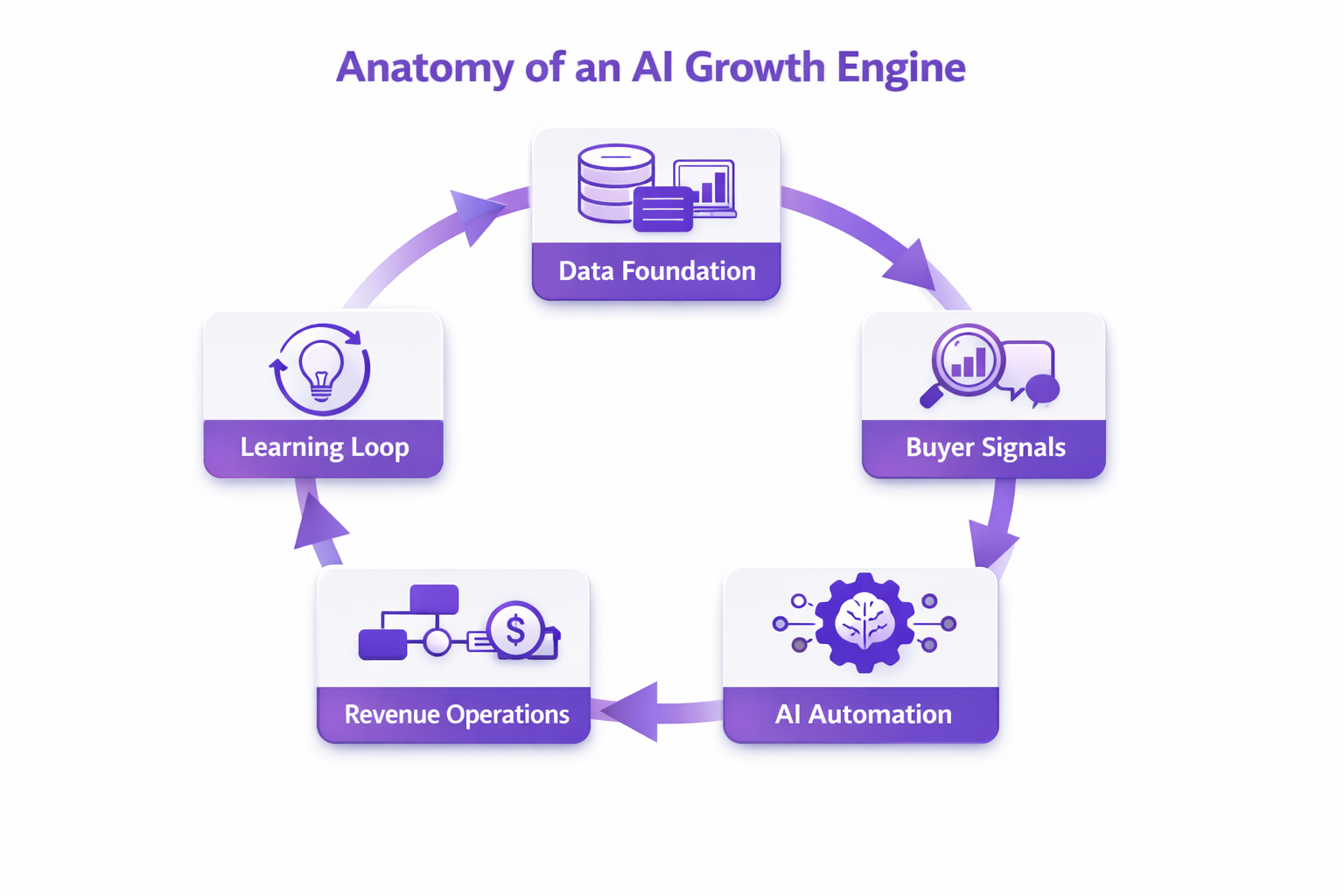
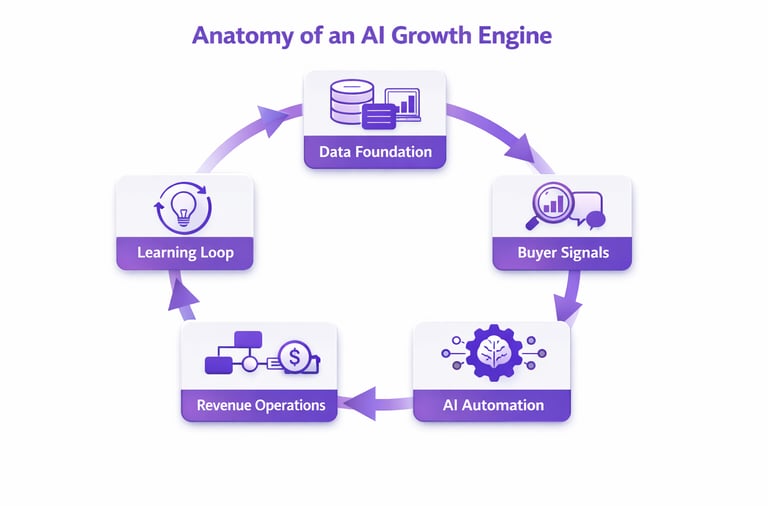
An AI growth engine is a sophisticated, data-driven system that automatically drives business growth by connecting insights, customer signals, and automated actions across your revenue funnel, from awareness to conversion and beyond. It doesn’t just use AI tools; it uses AI to run growth as an autonomous, always-improving system. This engine enhances pipeline predictability, reduces guesswork, and scales revenue performance.
In simple terms: an AI growth engine lets your business grow itself by continuously learning what works and optimizing every step of the customer journey based on data and intelligence, not manual decisions.
🚨 The Problem: Growth Isn’t Automatic, Yet
Most B2B companies struggle with:
Disconnected tools (CRM, marketing, analytics, sales systems siloed)
Manual workflows that slow response times
Fragmented data that makes strategic optimization guesswork
Reactive decisions instead of predictive ones
The result? Growth that’s inconsistent and expensive, even when you think you’ve invested in AI. The reality is that AI tools alone don’t make growth automatic. Only when AI is embedded into a system designed to drive revenue continuously do you get true growth acceleration
🧠 What Is an AI Growth Engine?
An AI growth engine is a connected system that:
Collects data and signals from across your business
Interprets that data in real-time
Makes or recommends actions that drive measurable growth
This is more than automation. It’s about AI reasoning with purpose, identifying what moves revenue, why it matters, and what to do next.
One definition from industry analysis explains that an AI growth engine “scans your business, your customers, and your competitors to show what will drive measurable revenue growth”, and turns insights into actionable steps rather than static dashboards.
🧱 Core Building Blocks of an AI Growth Engine
1. Data Foundation: The Intelligence Layer
A growth engine needs clean, centralized data from your CRM, website, campaigns, sales motions, and service interactions. Without this foundation, AI can’t spot patterns or learn over time.
2. Signal Capture: Detect Intent Early
AI constantly listens for buyer signals, such as search behavior, content engagement, email replies, or product interactions, and scores prospects based on real-time engagement and intent.
3. Automated Conversion Paths
Rather than static workflows, the engine triggers personalized actions:
Dynamic messaging
AI-driven lead scoring
Intelligent routing to sales
Tailored nurture sequences
This means customers get the right message at the right time, automatically.
4. Unified Revenue Operations (RevOps) Layer
AI growth engines unify sales, marketing, and customer success data and workflows into a single revenue stack, ensuring seamless handoffs and shared visibility.Medium
5. Continuous Learning & Optimization Loop
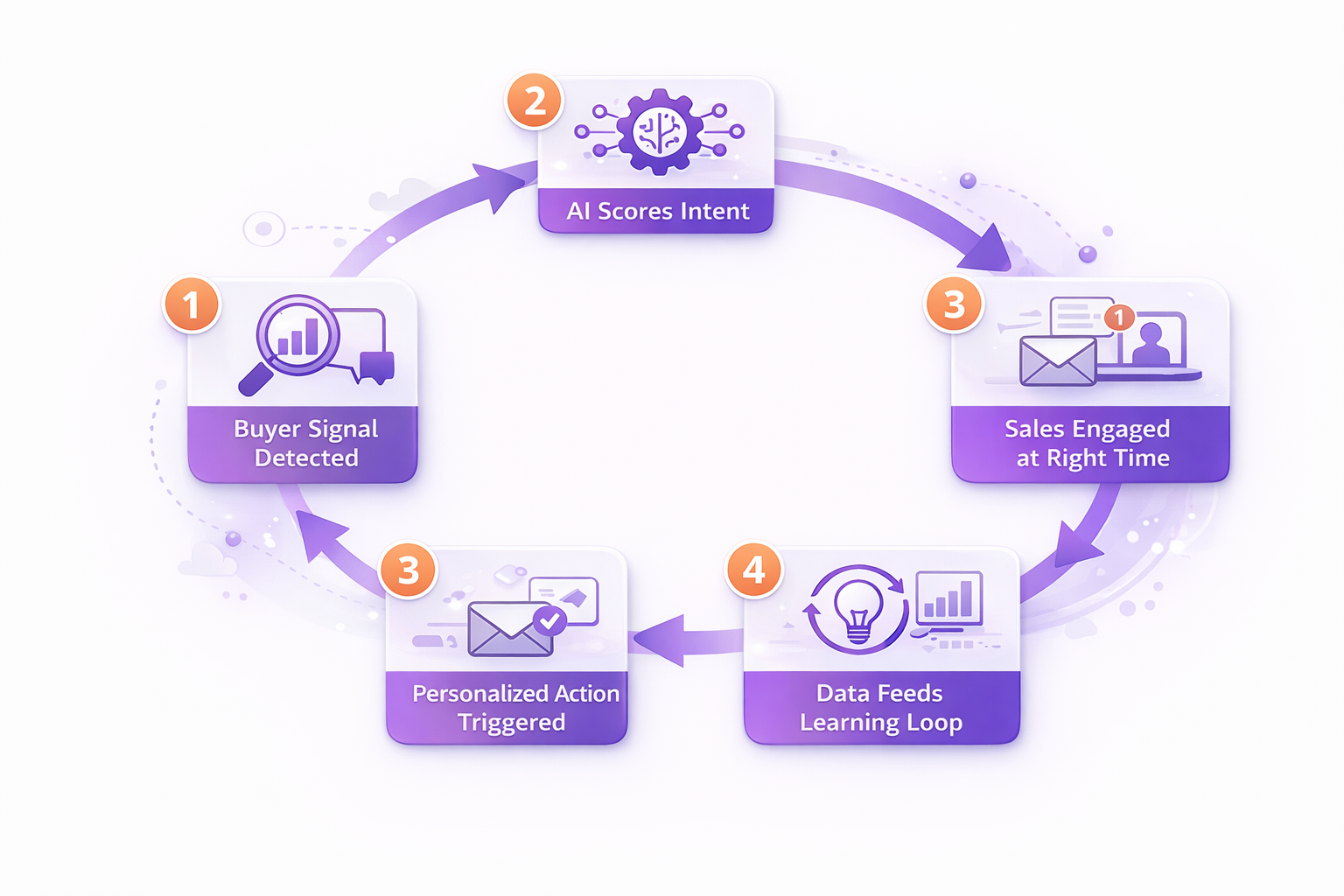
Every interaction feeds back into the system. The engine learns what converts, what stalls, and what closes, improving itself over time. This loop transforms data into strategic advantage.
Step-by-Step: How It Actually Works
Here’s the growth engine in action:
Signal Detection: A buyer engages with your content, search, or product.
AI Interpretation: The engine scores the lead and segments them based on behavior and intent.
Automated Action: Personalized outreach, content delivery, or sales notifications are triggered.
Outcome Tracking: The system tracks results, conversions, pipeline movement, revenue, in real time.
Self-Optimization: AI updates scoring models and workflows based on what’s working, improving future performance.
Unlike rule-based automation, this process learns and adapts, just like a traditional growth engine should.
The Value: Data-Backed Impact of AI-Driven Growth
While “AI growth engine” as a phrase is emerging, real data shows the impact of AI on revenue systems:
AI predictive analytics and automation can reduce sales cycle length by ~25% and increase conversion rates by ~30%, according to industry analysis of AI sales pipeline tools.
Companies adopting AI in B2B sales automation report 15–20% growth in qualified leads and revenue growth improvements, per market research.
McKinsey data indicates AI can unlock 5–15% productivity gains in marketing and enhance decision-making.
These figures demonstrate that when AI is integrated into revenue systems, not just isolated tools, the payoff is measurable.
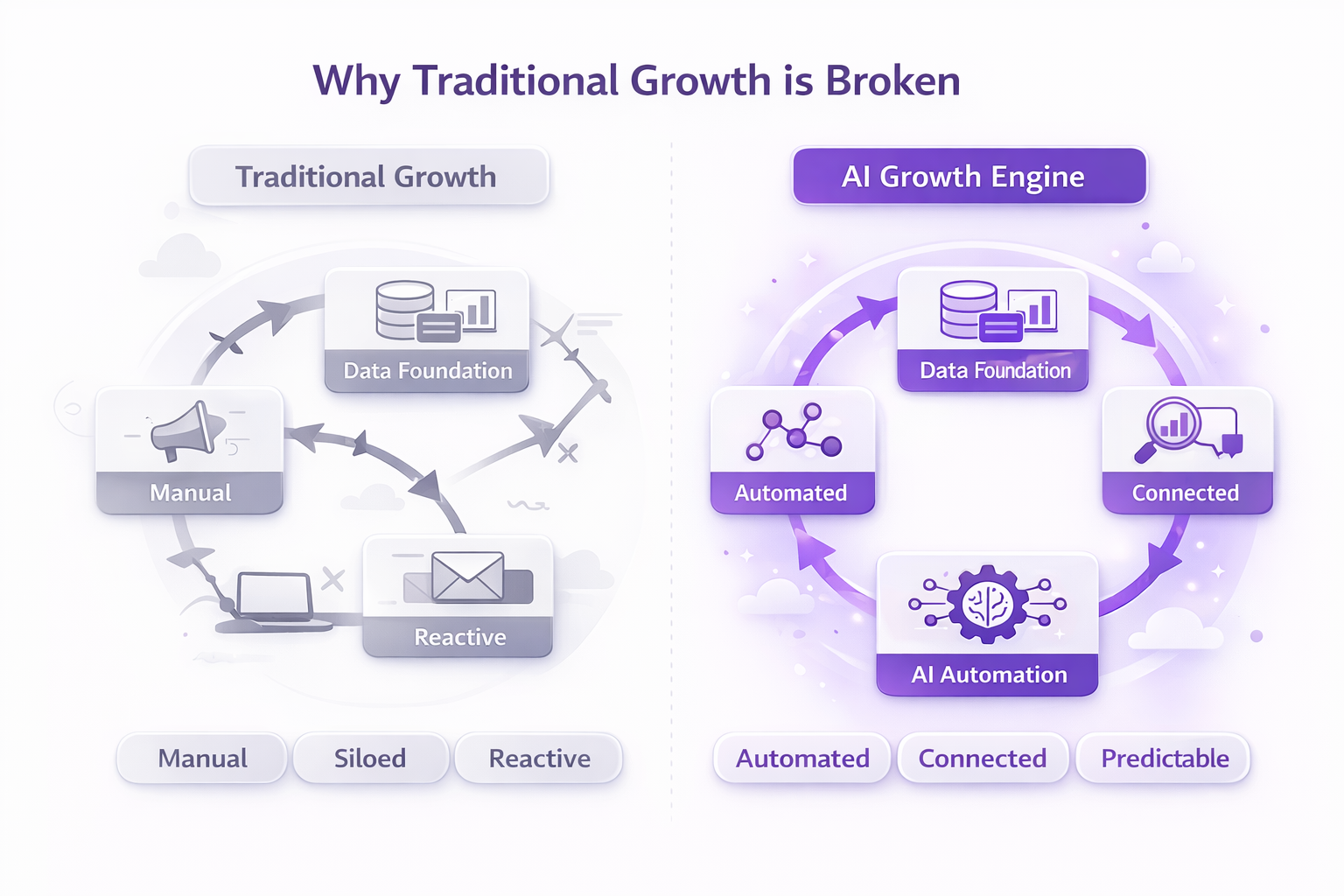
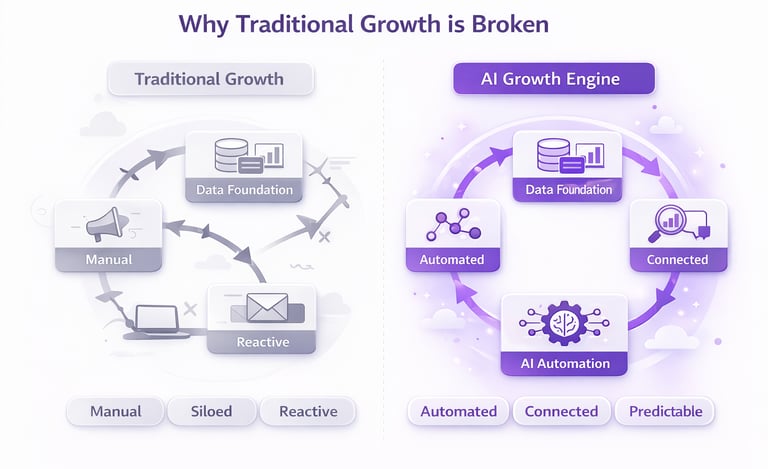
AI Growth Engine vs Traditional Tech Stack
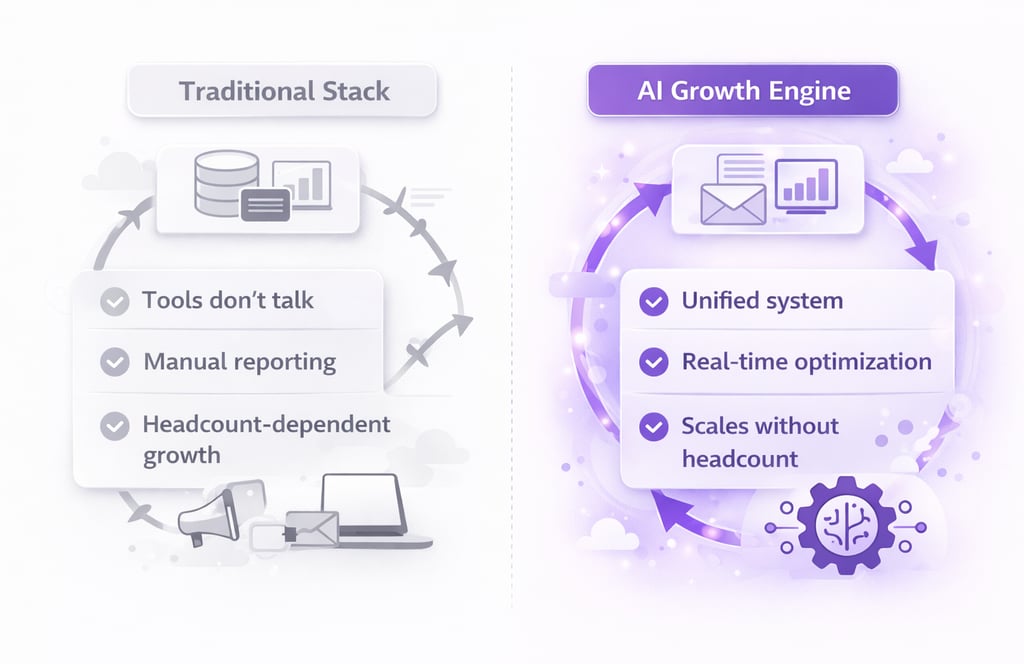
Traditional Stack
Standalone tools
Manual data reconciliation
Reactive execution
Growth depends on human bandwidth
AI Growth Engine
Integrated system
Automated intelligence
Real-time optimization
Growth scales without added headcount
A traditional marketing stack might generate reports; a growth engine acts on insights automatically.
Why Most Companies Fail to Build One
Companies often fall short because they:
Buy tools without designing an underlying system
Keep data in silos
Lack centralized revenue operations
Treat AI as a fad instead of a growth framework
The truth is that AI amplifies strength, it doesn’t fix weak processes.
📈 Outcomes of a Successful AI Growth Engine
When properly implemented, an AI growth engine can deliver:
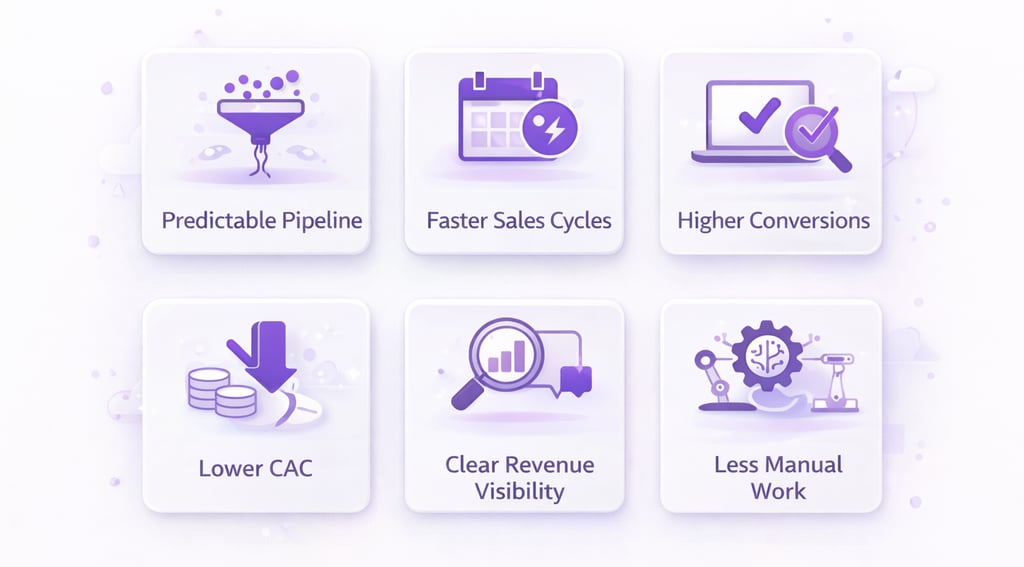
Predictable pipeline generation
Shorter sales cycles
Higher conversion rates
Efficient resource allocation
Real-time revenue forecasting
Continuous performance improvement
This shift transforms growth from reactive and chaotic to predictable and strategic.
How Forsify Helps You Build Growth Engines
At Forsify, we help businesses move beyond tool stacks to engineered growth systems:
Revenue strategy & GTM alignment
AI-powered pipeline generation
Marketing automation + RevOps infrastructure
Predictive performance insights
Systems that learn, optimize, and scale
We don’t just install tools, we architect growth engines designed for predictable revenue outcomes.
Frequently asked questions
1. What exactly does Forsify do?
Forsify operates as an AI-powered marketing department that designs, builds, and runs growth systems end to end.
We engineer:
Market positioning and messaging
Authority and demand creation
Outbound, inbound, and nurturing systems
Continuous experimentation and optimization
Our goal is not “more leads” it’s predictable, scalable growth.
2. How is this different from a marketing agency?
Agencies execute tasks. Forsify creates and runs growth engines.
With Forsify, you get:
Growth architecture, not isolated campaigns
AI-driven execution across content, outreach, and nurturing
Continuous testing, iteration, and learning
One integrated system instead of disconnected tools and vendors
We function like a senior in-house marketing team, without the overhead.
3. What problems does Forsify solve?
Forsify solves structural growth problems, including:
Inconsistent demand and revenue volatility
High CAC from paid channels alone
Fragmented marketing tools and teams
Lack of ownership over growth strategy and execution
We replace guesswork with a repeatable, data-driven growth engine.
4. Who is this best suited for?
Forsify works best for:
B2B companies and startups with complex sales cycles
Teams selling high-ACV products or services
Founders who need growth without building a large internal team
If growth is strategic to your business, not an experiment, this is a fit.
5. What does the AI Marketing Department include?
Depending on your configuration, it may include:
Positioning, ICP, and messaging engineering
Authority-building content and thought leadership
Automated outbound and demand capture
Lead nurturing and conversion systems
Analytics, reporting, and optimization loops
All components are designed to work together as one system.
6. How long does it take to see results?
Growth is engineered in phases:
Setup Sprint:
Strategy, infrastructure, ICP, workflows, content, and channel warm-upExecution Phase:
The system goes live, compounds over time, and improves through testing
Meaningful traction typically appears within 20–40 days, with compounding results over time.
7. Is Forsify replacing our internal marketing team?
Not necessarily.
Forsify can:
Act as your entire marketing department, or
Work alongside internal teams to design and run growth engines
We integrate into your existing structure rather than compete with it.
8. How much involvement is required from our team?
Minimal executive involvement.
You’ll be involved in:
Strategic alignment and approvals
Monthly reviews and optimization decisions
Day-to-day execution is handled by Forsify and AI-powered systems
9. Do you only focus on outbound and pipelines?
No.
Pipeline creation is one outcome, not the product.
Forsify focuses on:
Demand creation
Brand authority
Conversion optimization
Long-term growth infrastructure
Pipelines improve because the system works, not because we push volume.
10. How do you measure success?
Success is measured by:
Growth in qualified demand
Conversion rates across the funnel
Cost efficiency versus internal teams
Strategic impact on revenue
KPIs are defined upfront based on your business model.
Forsify
Transform Your Business with AI.
149 New Montgomery st., San Francisco, CA
info@forsify.com
© 2026. All rights reserved.